
Digital Marketing Services In 2025 connected world, reaching customers means reaching them OnlineBy 2025, businesses that lack a strong digital presence will struggle to grow or even survive. As Adobe puts it, “Digital marketing services is no longer optional — it’s essential. Consumers now spend most of their time on devices and the internet, so companies must meet them there. With billions of people on social media, search engines and mobile apps, a smart digital marketing strategy lets businesses connect with a vast audience across the globe. In short, Digital Marketing Services has become a game-changer and an indispensable growth tool for any organization.
Digital marketing Services uses online channels – like search engines, social media, email, websites, and ads – to promote products and services to the right people. Unlike traditional “one-way” ads (billboards or print), digital marketing is dynamic and interactive: customers can engage instantly, leave feedback, and share content. Its effectiveness is backed by data: digital campaigns can be tracked in real-time, so marketers know exactly what is working and what isn’t. As businesses of all sizes adopt smartphones, AI, and voice assistants, leveraging Digital Marketing Services means reaching customers where they already live – on phones, apps, and social feeds – making it the most powerful way to grow in 2025.
Table of Contents
What Is Digital Marketing Services ?
Digital marketing Services refers to any marketing efforts that use digital devices or the internet. It encompasses tactics like online advertising, social media, email campaigns, content creation, and more In practice, a company might leverage:
- Websites and Blogs: Your website is the home base where customers learn about you.
- Search Engines: Optimizing content so you appear in Google (SEO) or using paid search ads (PPC).
- Social Media: Platforms like Facebook, Instagram, Twitter and LinkedIn for branding and engagement.
- Email: Sending newsletters and offers directly to subscribers. for that you can use tools like mailchimp
- Mobile & Apps: Engaging users through apps, SMS, or mobile ads.
Adobe’s Digital Marketing Services guide defines digital marketing as “the use of digital channels to market products to boost brand awareness, drive traffic, and hit marketing goals. Whether you’re a small startup or a global enterprise, the core principle is the same: use online tools and data to reach your target audience effectively. Digital marketing Services relies on consumer data and analytics so you can deliver the right message to the right person at the right time.
Major Types of Digital Marketing Services
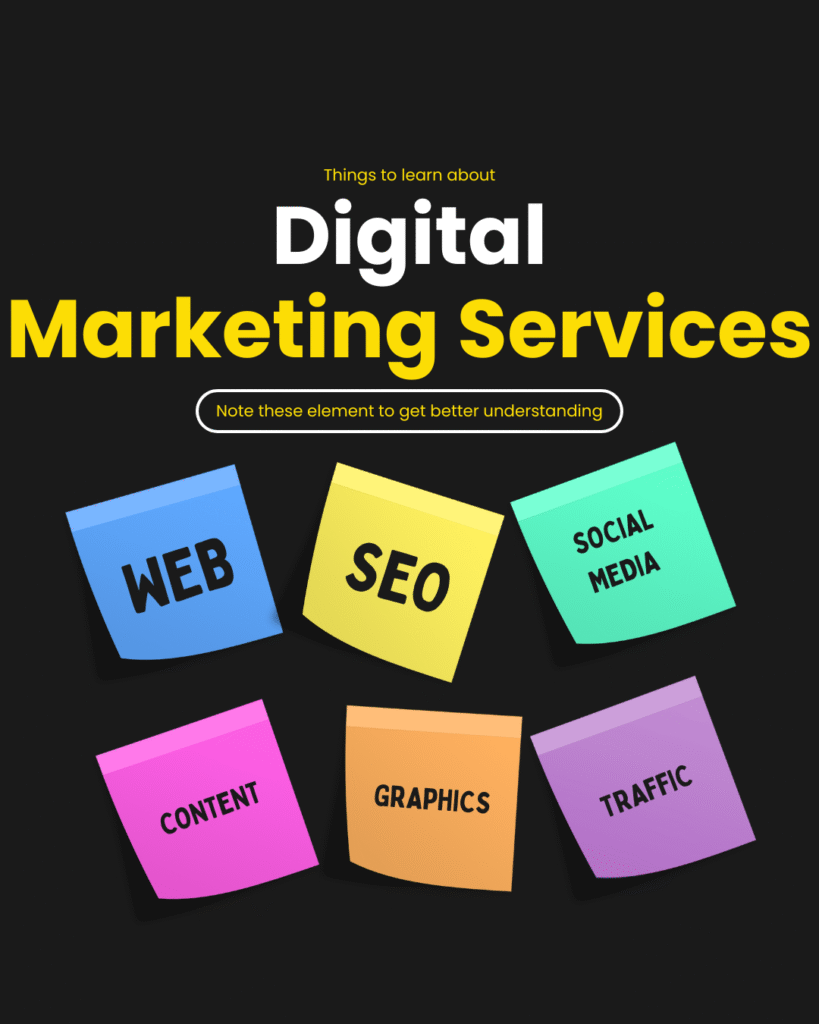
Modern digital marketing is a mix of specialistservices. Here are the key typeis ofDigital Marketing Services businesses use:
- Search Engine Optimization (SEO): Improving a website’s content and structure so it ranks higher in search engines like Google. SEO attracts organic traffic by targeting keywords and user intent. For example, an SEO agency might optimize your site so that when people search for “best running shoes,” your store appears at the top of results.
- Pay-Per-Click (PPC) Advertising: Running paid ads (e.g. Google Ads or Facebook Ads) where you pay each time someone clicks your ad. PPC campaigns can put your offers in front of users immediately and allow very precise budgeting. AMA explains that with PPC, “a business only pays for its ads when a person clicks on them. This makes PPC highly measurable: every click, view, and conversion is tracked.
- Social Media Marketing (SMM): Using social networks (Facebook, Instagram, Twitter, LinkedIn, TikTok, etc.) to build brand awareness and engage customers. SMM includes posting content, running paid social ads, and interacting with followers. It often involves influencer marketing – partnering with individuals who have large, engaged followings. As AMA notes, SMM “is the practice of using social media channels to promote business products or services”, often leveraging influencers to boost reach.
- Email Marketing: Sending targeted emails or newsletters to subscribers and past customers. Email campaigns are used for promotions, updates, and nurturing leads. AMA describes it as sending “branded, promotional content directly to prospective customers via email. Despite being one of the oldest online tactics, email remains powerful in 2025 for its personalization and direct ROI.
- Content Marketing: Creating valuable content (blog posts, videos, infographics, e-books, podcasts) that attracts and retains a clearly defined audience. The aim is to educate or entertain so customers trust your brand. According to AMA, content marketing means “the publishing and distribution of text, video or audio materials to customers online. Blogs, videos and podcasts are common ways for businesses to engage in content marketing. In practice, a content marketer might write how-to guides or produce TikTok videos that position a company as an industry expert, driving organic traffic and leads.
- Web Design & Development: Designing, building, and optimizing your website or app. Your website is often the hub of your online presence. A professional website provides a positive user experience, helps SEO, and serves as the endpoint for many campaigns. As AMA notes, businesses “leverage websites… to reach customers. In 2025, web developers also ensure mobile optimization, fast loading, and integration with marketing tools (like analytics and chat).
- Influencer Marketing: Collaborating with social media “influencers” – users with large, engaged followings – to promote your brand. Influencers can create authentic content around your product, driving word-of-mouth and trust. For example, a makeup brand might send free products to a beauty vlogger in hopes she features them in a review. Influencer marketing has exploded in value (predicted to exceed $24B by end of 2024), because consumers often trust peer recommendations.
- Other Services: This umbrella can include affiliate marketing, video advertising (YouTube ads), mobile marketing (SMS, app ads), and analytics/strategy services. Any service that uses digital technology to promote a business can fall under the digital marketing category.
Each of these services can be used alone, but most businesses see the best results by combining several in an integrated strategy. For example, a retail company might use SEO and PPC to capture search traffic, run Instagram ads to build brand awareness, send weekly emails to customers, and publish blog content to answer customer questions – all guided by data.
The Role of Artificial Intelligence (AI) and Automation in Digital Marketing Services 2025
In 2025, Artificial Intelligence (AI) and automation are no longer just buzzwords—they have become the backbone of modern digital marketing services. Businesses today are expected to deliver faster, smarter, and more personalized experiences, and AI provides the tools to make this possible. From analyzing massive datasets to automating repetitive tasks, AI and automation are reshaping how marketers connect with customers, optimize campaigns, and drive measurable growth.
Smarter Data Analysis and Insights
One of the biggest challenges marketers face is understanding consumer behavior. AI-powered tools in 2025 can process vast amounts of data in real time—search trends, browsing history, purchase patterns, and even social conversations. This means businesses can identify customer preferences more accurately than ever before. Instead of relying on guesswork, marketers use predictive analytics to forecast what customers want, when they want it, and the best channel to reach them. This data-driven decision-making not only improves ROI but also ensures brands stay competitive in fast-changing markets.
Hyper-Personalization at Scale
Consumers now expect highly tailored experiences. AI enables hyper-personalization by delivering content, offers, and product recommendations that match individual needs. For example, an e-commerce store in 2025 can show different homepage banners to different users based on their past interactions. Similarly, email campaigns can be customized automatically, with subject lines, product suggestions, and send times optimized for each recipient. This level of personalization builds stronger customer loyalty and significantly improves conversion rates.
Automation of Repetitive Tasks
Repetitive tasks such as scheduling posts, sending follow-up emails, or segmenting customer lists can take up valuable time. With automation tools, marketers in 2025 can streamline these processes effortlessly. Social media management platforms can auto-publish content across multiple channels, while chatbots handle routine customer inquiries 24/7. Automation doesn’t just save time; it frees marketers to focus on strategy, creativity, and long-term growth initiatives instead of manual execution.
AI-Powered Advertising
Paid advertising has also seen a transformation. Platforms like Google and Meta increasingly rely on AI-driven algorithms to optimize bidding, targeting, and ad placements. In 2025, advertisers use AI tools to automatically adjust campaigns based on performance data—ensuring that every dollar spent reaches the right audience. AI can even generate ad creatives, test multiple versions instantly, and identify which message resonates most with customers. This reduces wasted ad spend and maximizes impact.
Conversational Marketing with Chatbots
Another major development is the rise of AI chatbots and voice assistants. Customers no longer want to wait for human responses—they expect instant answers. AI-powered chatbots can handle inquiries, suggest products, and even close sales directly within messaging apps or websites. By providing immediate support, brands enhance customer satisfaction while reducing service costs. Voice assistants like Alexa and Google Assistant are also becoming key marketing channels, as consumers increasingly use voice search to discover products.
Predicting Future Trends
Beyond current applications, AI helps marketers anticipate the future. Predictive AI models analyze emerging trends, helping brands prepare for shifts in consumer demand. For instance, AI tools might flag a growing interest in eco-friendly products, enabling a business to adjust its campaigns before competitors catch on. This proactive approach keeps companies ahead of the curve.
Key Benefits of Digital Marketing Services for Businesseshttps://gargidigitalmarketing.com/
Digital marketing offers many advantages over traditional marketing:
- Global Reach: You can reach customers anywhere in the world. Digital channels are not limited by geography. AMA highlights that digital marketing “is not necessarily bound to a specific geographic area”, letting small businesses access national or international markets. For example, a small craft shop with a good website and SEO can sell overseas, something unimaginable with only local print ads.
- Cost-Effectiveness: Many Digital Marketing Services tactics are cheaper than traditional media. Adobe notes that digital channels (social posts, blogs, email) have very low cost beyond time and effort. Even paid ads on Google or Facebook can be started with modest budgets and scaled up. This low barrier makes Digital Marketing Services attractive for startups and small businesses.
- Measurable ROI: Unlike TV or print, every click, view and conversion online can be tracked. Digital marketing provides real-time analytics so you know exactly how campaigns are performing. You can monitor website traffic, engagement, and conversion rates minute-by-minute. This transparency enables data-driven decisions: if an ad or keyword isn’t working, you can pause or adjust it immediately to maximize ROI.
- Precise Targeting & Personalization: Online ads can be targeted to very specific audiences – by age, interests, location, behavior, and more. This precision means your marketing budget is spent on people most likely to convert. Adobe highlights that Digital Marketing Services lets you segment customers and customize messaging for each group. For instance, Facebook Ads allow you to show a winter coat ad only to users in cold climates who like outdoor sports.
- Flexibility and Speed: Digital campaigns can be launched or changed quickly. If an ad or strategy isn’t working, marketers can tweak it on the fly (adjusting wording, creative, or budget). AMA notes that digital marketing is highly adaptable, unlike traditional campaigns which often run fixed long-term. In fast-changing markets, this agility is critical.
- Stronger Customer Engagement: Through social media, blogs, and email, brands can interact directly with customers and build relationships. Effective social media marketing fosters community and loyalty. AMA mentions that businesses can build “longtime and loyal relationships with current and prospective customers” through digital channels. Engaging content, user-generated reviews, and two-way conversations help humanize a brand and turn customers into advocates.
- Insights and Optimization: Every action online leaves data. By analyzing this data, companies learn about customer preferences and behavior. SociallyIn points out that digital marketing “offers real-time data and analytics” to continuously refine strategies. Over time, this leads to smarter campaigns and better results.
Together, these benefits mean more efficient, effective, and flexible marketing. For Digital Marketing in 2025, Adobe sums it up: digital marketing lets businesses “connect with customers, build brand awareness, and drive growth” in a competitive marketplace.
Real-World Examples
The impact of Digital Marketing Services can be seen across industries. Here are a couple of illustrative examples from recent years:
- Local Retail (Bakery): A small family-owned bakery used to rely on foot traffic in its town. By embracing social media and local SEO, it suddenly attracted customers from nearby towns. The bakery shared engaging photos and behind-the-scenes videos on Instagram and Facebook, building an online following. Simultaneously, it optimized its Google Business profile so it appeared on local searches (e.g. “best cupcakes near me). The result? A surge of new customers who discovered the bakery online and decided to visit in person. This case shows how digital marketing can dramatically expand the reach of a traditional business.
- Niche E-commerce (Eco Jewelry): An eco-friendly jewelry brand wanted to find customers who care about sustainability. The company ran targeted Facebook and Instagram ads highlighting its unique, handmade designs. It also partnered with a few mid-tier eco-conscious influencers, who featured the jewelry in social posts and stories. Through this strategy, the brand connected with its ideal audience – people who value green products – and built a community around its mission. Over time, this led to higher sales and repeat customers. This example illustrates how combining social ads and influencers can help a niche business find its market.
- Global Brand (Nike, Nike Run Club App): Nike famously uses digital to engage athletes worldwide. For example, its Nike Run Club app sends personalized coaching and tracks millions of runners. Campaigns on social media and partnerships with fitness influencers encourage sharing and community. Such efforts boost Nike’s sales and brand loyalty. (While proprietary, these strategies align with the trends experts cite: using mobile, data, and influencers to connect with users.)
- B2B Marketing (Tech Startup): A B2B software company might use LinkedIn marketing and SEO to reach decision-makers. By publishing helpful white papers and case studies, they establish thought leadership. Paid search ads target keywords like “enterprise CRM software” and lead to product demos. Email drip campaigns nurture leads through the longer B2B sales cycle. These tactics – common in digital marketing services – help close deals for tech firms.
In each case, digital channels enabled strategies that weren’t possible with offline methods alone. The SociallyIn case studies above show how small businesses can even compete with bigger brands by leveraging digital tools.
Conclusion and Call to Action
Digital marketing is no longer the future — it’s the present. In 2025, any business that wants to grow and compete must invest in Digital Marketing Services. By combining SEO, advertising, social media, email and great content, companies can reach more customers, track results in real time, and adapt faster than ever. The benefits are clear: broader reach, lower costs, precise targeting, and stronger customer relationships.
If you haven’t already, take action now. Start by auditing your current online presence: is your website optimized? Are you visible in search? Do you engage customers on social media or via email? Then, consider building a strategic Digital Marketing Services plan. You might hire experts or use specialized agencies to help with SEO, PPC, content or social campaigns. The key is to start — even small steps like creating a social profile or sending a monthly newsletter can make a big difference.
Remember: your customers are online. Every day not spent on digital marketing is a missed opportunity. Embrace digital marketing services to future-proof your business in 2025. Let the data guide you, and focus on providing value at every click and post. By doing so, you’ll build brand awareness, increase sales, and ensure your business thrives in the digital age.